A concertina is a small, hand-held instrument with a lot going on inside: bellows, valves sealed with wax, and finely tuned reeds. The design has barely changed since the mid-1800s, and it is still a precision instrument that needs a little routine care. This guide, based on the Trinity College concertina care guide, covers what each part does, how to open and close the bellows safely, and how to clean and store your concertina so it stays ready to play for years.
What are the parts of a concertina?
- Bellows: the folding middle section that moves air through the instrument when you push and pull.
- End-plates and reed box: the decorative ends. Behind them sit the reeds and the valves that make the sound.
- Buttons: each one opens a valve so air flows across a reed.
- Palm rest and wrist strap (Anglo models) or thumb strap and hand stop (English models): these hold the instrument steady in your hands.
- Air-release button: an extra button, usually on the right-hand side, that opens a valve without making a sound.
Why does the air-release button matter?
Think of a concertina as a hand-powered air pump with button-controlled valves. If you pull the bellows apart or squeeze them shut without a button open, the air has nowhere to go and the pressure can damage the bellows and valves. Always press and hold the air-release button before you open the bellows to start playing, and again when you close them at the end. It makes no sound, so you can use it in the middle of a tune too.
How do heat and cold affect a concertina?
The valves in a traditional concertina are sealed and held in place with wax, and that wax reacts to temperature.
- Heat and direct sun soften the wax. The valves can start to leak, and the whole valve assembly can lose its stability.
- Cold makes the wax hard and brittle, which can also weaken the seals and cause leaks.
Normal room temperature and humidity is best. A simple rule: never leave your concertina anywhere you would not be comfortable spending time yourself, such as a hot car, a cold garage or a sunny windowsill.
How do I clean a concertina after playing?
Wipe it down with a soft cotton cloth every time you finish playing. Skin oils, dirt and snack dust build up on the finish and around the buttons, where they can make the buttons stick and weaken the air seals. Keep a cloth in the bag or case so it is always at hand.
How should I store a concertina?
- Put it back in its gig bag or case as soon as you are done, and make sure the bag is zipped or the case is latched so it cannot fall out.
- Keep the bag or case somewhere safe, away from heat, cold and direct sun.
Anglo vs English concertina button layouts
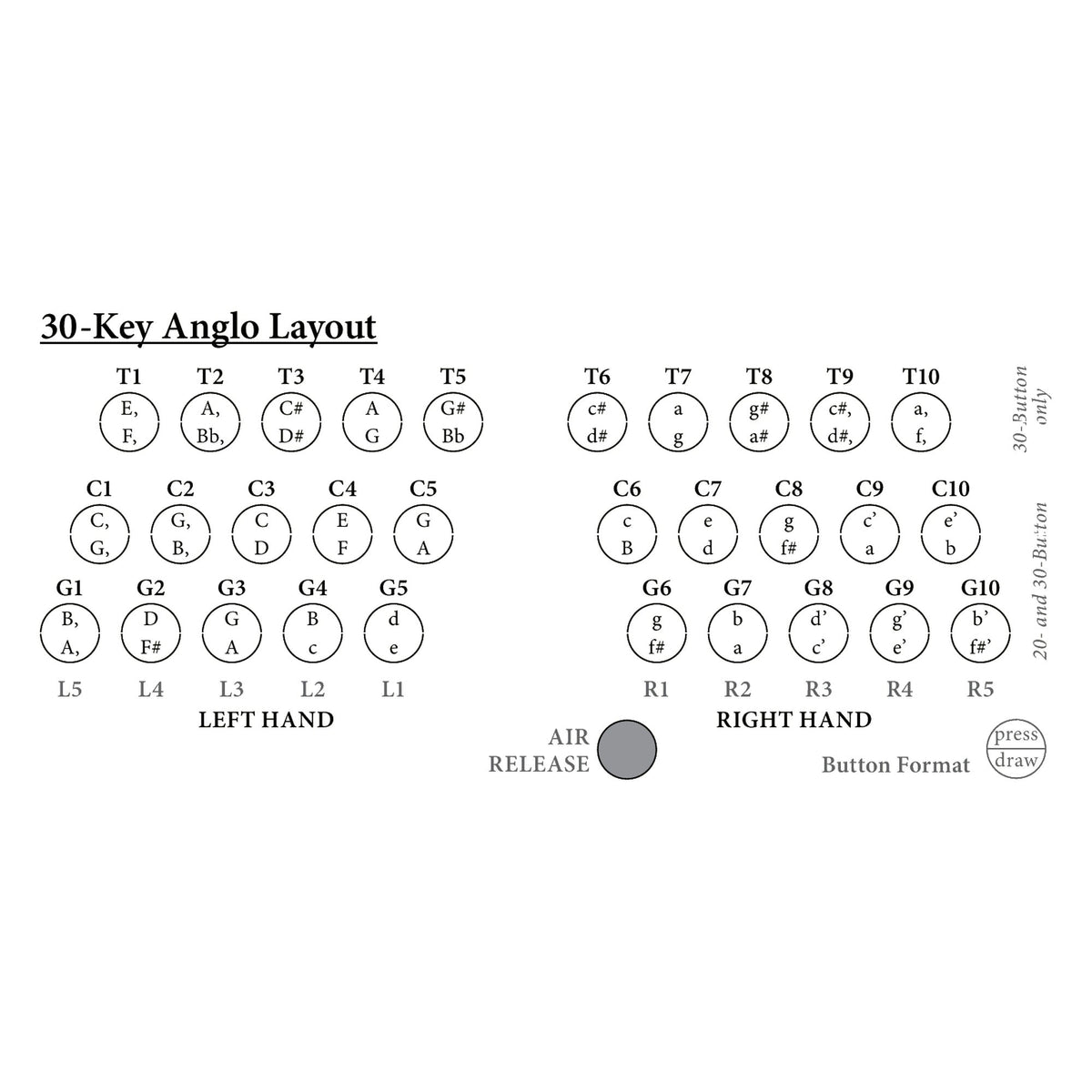
Anglo concertinas are bisonoric: each button plays one note when you press the bellows in and a different note when you draw them out. They are usually set up in C and G. English concertinas are unisonoric: each button plays the same note in both directions, and the notes alternate between the left and right hands. These sample charts show where the notes sit.

On the Anglo chart, the top half of each button is the press note and the bottom half is the draw note. A 20-button C/G Anglo has the bottom two rows (C and G). A 30-button model adds the top row of accidentals.

Trinity College concertinas at Terry Carter Music Store
- Trinity College AP-20A 20-button Anglo (red)
- Trinity College AP-1120A 20-button Anglo (black)
- Trinity College AP-1130A 30-button Anglo (black)
- Trinity College AP-1230A 30-button Anglo (walnut)
- Trinity College AP-3530A handmade 30-button Anglo
- Trinity College AP-2230A 30-button English
- Trinity College AP-2248A 48-button English
Where can I learn more about the concertina?
- Concertina.com: a reference library of documents on English, Anglo and duet concertinas.
- Concertina.net: an online forum for concertina players.
- Concertina.org: the International Concertina Association, which connects players around the world.